



“State of the Union” 2026: Key messages for the European construction industry
Several announcements are particularly relevant for the European construction sector:
- Further proposals to accelerate permitting procedures for projects of strategic European interest;
- Continued efforts to reduce administrative burdens and tackle regulatory complexity;
- Increased investment in electricity grids, storage and energy infrastructure to support electrification;
- A forthcoming Climate Resilience Framework focusing on adaptation, flood prevention, water management and preparedness. A new European Water Initiative will be put forward;
- Continued action on housing affordability following the proposal of the first European Housing Act;
- New initiatives to strengthen industrial competitiveness, access to finance and strategic supply chains;
- Continued support for Ukraine, including new programmes for cooperation with Ukrainian companies.
FIEC welcomes the recognition that Europe’s competitiveness and resilience depend on faster project delivery, modern infrastructure, secure energy systems and long-term investment.
The construction industry stands ready to support the delivery of Europe’s economic, climate and strategic objectives through the planning, construction and renovation of the infrastructure and buildings needed for a sustainable and competitive future.
Click here to read the SOTEU speech – Checked against delivery.
| FIEC ARTICLE |

“Fair Labour Mobility” package: EU to simplify cross-border work
On 15 September, the European Commission adopted the Fair Labour Mobility package, including a Communication and five legislative proposals, designed to facilitate labour mobility in reducing administrative burden for employers and facilitating the recognition of qualifications for workers.
The package includes:
– A Regulation on the European Social Security Pass (ESSPASS), which will allow workers to request, hold and present social security documents, including the European Health Insurance Card and the Portable Document A1 (PDA1) for posted workers, digitally, via the EU Digital Identity Wallet.
– A revision of the European Labour Authority (ELA) mandate to give ELA stronger tools to support inspections, cooperation, better enforcement, and include third-country national workers in the scope.
– A Skills Portability Act to introduce standardised digital qualifications and a free EU-wide comparison tool.
– A revision of the Professional Qualifications Directive which will move recognition procedures for regulated professions online, cutting processing time from three months to five weeks.
– A Directive on the recognition of qualifications for third country nationals, reducing average recognition time from 14 months to 4.
The Commission estimates the package could generate around €6 billion in cumulative benefits by 2040, through faster qualification recognition, real-time verification of social security documents, and reduced fraud.
The proposals are now subject to negotiations and approval by the European Parliament and the EU Council.
| Read more |

FIEC Technical Commission plenary – 2026 edition
On 21 September, the FIEC Technical Commission (TEC) came together for its annual high-level exchange to share highlights and achievements, discuss important policy dossiers currently affecting European contractors, and exchange views with the European Commission.
FIEC thanks its guest speakers from the European Commission, as well as all members for their active engagement and valuable input throughout the day.
| FULL ARTICLE |

Launch of the “Water Resilience Stakeholder Platform”
On 21 September, the Water Resilience Stakeholder Platform was officially launched at the European Economic and Social Committee (EESC) in Brussels. Its objective is to support the implementation of the EU Water Resilience Strategy.
FIEC has been appointed as a member, represented by Mr Antonios Papadakis, Electrical Engineer and Operations Director at Goliopoulos S.A. (Greece), and Mr Dominique Bouillot, Associate at FEW / Water Asset Development (France).
The platform will be jointly chaired by the European Commission and the EESC.
| Read more |
Joint Statement on psychosocial risks in the workplace
On 21 September, together with 9 employers’ organisations, FIEC published a Joint Statement on psychosocial risks in the workplace.
Ahead of the European Parliament’s plenary vote of 5 October on the INL report “Psychosocial risks, stress and mental health at work“, European employers call on Members of the European Parliament (MEPs) to reject the legislative annex and any other reference to the introduction of a new European legislation.
European employers stress that the focus should be on strengthening implementation and enforcement of the existing OSH framework (Occupational Safety and Health), providing practical guidance and tools, reinforcing social dialogue, etc. It is also important to respect the ongoing tripartite work of the Advisory Committee on Safety and Health at Work on the topic.
| STATEMENT |
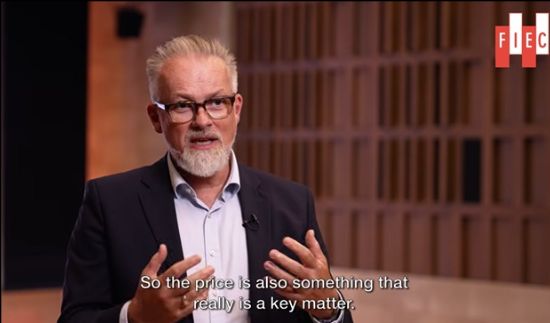
Video of the month: Interview with Rasmus Brandt Lassen (Denmark)
FIEC thanks Rasmus for featuring in our “Video of the Month“, and DI Construction (Danish member federation) for its continued collaboration.
| WATCH VIDEO |

GEBTP Luxembourg turns 75 years
This week, FIEC’s member, Groupement des Entrepreneurs du Bâtiment et des Travaux Publics (GEBTP), celebrates its 75 years representing Luxembourg’s construction industry within our federation.
Founded in 1946, the GEBTP was established by a group of entrepreneurs with the ambition of creating a representative organisation for Luxembourg’s construction sector. Over the decades, it has developed into the recognised voice of construction companies in the country, representing their professional, economic and social interests and maintaining a close dialogue with public authorities, economic stakeholders and social partners. Today, the federation gathers around 20,000 employees and their enterprises.
The federation’s work covers a broad range of issues affecting the construction industry, including economic and social developments, legislation, skills and training, waste management, and the energy and environmental performance of buildings. The GEBTP also places particular emphasis on innovation and on strengthening the competitiveness and future potential of Luxembourg’s construction sector.
Its history has also been closely connected to the European construction community. As FIEC’s Luxembourg member federation, the GEBTP has contributed to the exchange of experience and the representation of the sector at European level. Today, Joël Schons, a board member of the GEBTP, serves as a FIEC Vice-President and chairs FIEC’s Working Group “Housing”.
FIEC warmly congratulates the GEBTP, its members and its successive generations of leaders and people on this important milestone, and looks forward to continuing its close cooperation with the Luxembourg construction member in the years ahead.
| ABOUT GEBTP |