



3 June, EU Partner Event: “Lead Markets for low-carbon Cement”
The focus of the 2025 edition of the EU Green Week is on circular economy that offers a compelling solution to some of the EU’s most pressing challenges, notably the potential to drive sustainable competitiveness, to reduce waste, and to promote innovation.
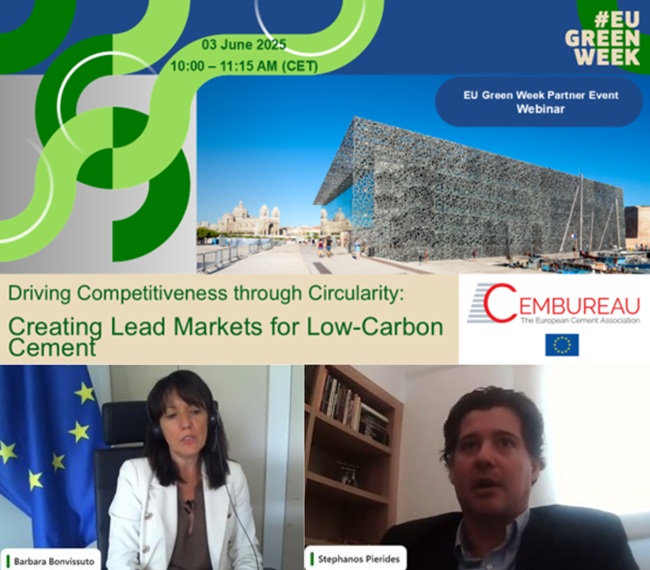
As partner of one of the events hosted in the frame of EU Green Week, Cembureau (European Cement Association) organised a webinar about “Driving Competitiveness through Circularity: Creating Lead Markets for low-carbon Cement”, with more than 300 attendees. Industry stakeholders exchanged with the European Commission about regulatory needs to achieve the ambitious net-zero target by 2050.
Cement is an important construction material and at the same time a major industrial emitter. Decarbonisation of the cement industry is therefore at the heart of the sustainable transition.
The construction sector is responsible for 33%t of the global CO2 emissions. However, Stephanos Pierides (Chairperson of the FIEC Sub-Commission “Environment”) explained that only one-fifth of these emissions come directly from the construction process (like on-site assembly). The vast majority of emissions (81%) are primarily linked to the production and use of the materials and products themselves. Reducing the carbon footprint of those construction materials must remain key, and there are various ways to achieve that. Barbara Bonvissuto (Director of Ecosystems III: Construction, Machinery and Standardisation at the European Commission – DG GROW) underlined that public procurement accounts for 15% of GDP and therefore provides a huge lever to push for low-carbon materials. High costs of construction have been identified as a major contributing factor to the housing crisis in Europe. Any policy action must therefore maintain a level playing field among construction materials, which is an important condition for innovation in the built environment and to guarantee the competitiveness of the industry.
Under the umbrella of the Clean Industrial Deal, the European Commission is currently working on “green” labels for industrial products, starting with steel in 2025, followed by cement. Furthermore, an Industrial Decarbonisation Accelerator Act will lay the legislative foundation for voluntary “green” labels and is expected to be published by end of 2025. Those labels might subsequently be connected to the Public Procurement Framework (2026 revision) as a mandatory non-price criterion.
| Read more |
FIEC at the “European Housing Forum”, 2 June
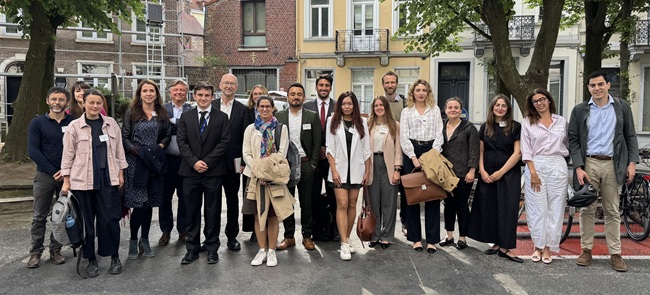
On 2 June, FIEC Director for Social Affairs, Christine Le Forestier, was at the first meeting of the European Housing Forum (EHF) with Matthew Baldwin, Head of the European Commission’s “Housing Task Force”, and Deputy Director General at DG ENER.
Forum members, representing a broad spectrum of the EU housing sector, introduced their associations and reaffirmed their commitment to supporting the development of the European Affordable Housing Plan.
“Housing” is a core topic among FIEC’s priorities and activities. This is why we released our position in a full paper released last year.
About the EHF
The European Housing Forum (EHF) is an informal platform gathering representative organisations of the entire housing sector – consumers, providers and professionals – in order to share their expertise and raise the issues that this sector faces towards the EU institutions. The Forum currently has 15 members, all of which are major international or European organisations working in the area of housing. It was created in 1997, following the adoption of a resolution on the social aspect of housing by the European Parliament.
ELA evaluation report is out
It was awaited since August 2024 and on 26 May, the European Commission published its evaluation of the European Labour Authority (ELA), established by Regulation (EU) 2019/1149 in June 2029 and since based in Bratislava.
Overall, the evaluation highlights that ELA has played a crucial role in enhancing cooperation between national authorities. In particular, it has facilitated and supported Concerted and Joint Inspections on posted and other mobile workers in different sectors. In addition, ELA has improved access to information on labour mobility for workers, employers and social partners.
The evaluation also highlights challenges related to staffing, budget management and budget execution. It also provides guidance to further improve the execution of specific activities and enhance synergies between these activities: e.g. improving the monitoring system, increasing the integration and coherency of the various activities, better integrate digital tools and innovation, better evaluate the impact of its communication campaigns, consolidate the EURES (European Employment Service) network, etc.
In conclusion, the evaluation points out that there is room to improve ELA’s performance based on its current mandate and objectives. However, it also indicates that some potential areas for improvement could require a revision of its founding Regulation, including competences to handle personal data, a strengthened ability to request cooperation from Member States on Concerted and Joint Inspections, the possibility to better address the situation of third-country nationals, and exert more influence on the appointment of National Liaison Officers.
Against this background, EU Executive Vice President Roxana Minzatu already announced that she intended to look into how to strengthen the European Labour Authority.
While the trade unions have called for a long time for an extension of ELA’s mandate, until now, employers have always considered that it was sufficient to achieve its objectives.
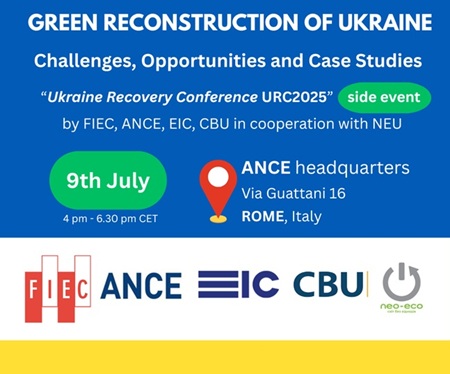
9 July, Rome
“The Green Reconstruction of Ukraine”, side event at URC 2025
On 9 July 2025 in Rome, FIEC will co-organise a high-level side event in the framework of the Ukraine Recovery Conference 2025, together with ANCE (Italian member of FIEC, Associazione Nazionale Costruttoti Edili), EIC (European International Contractors), CBU (Ukrainian member of FIEC, Confederation of Builders of Ukraine), and in cooperation with Neo-Eco Ukraine. The event will take place at ANCE headquarters in Rome and will be followed by a networking cocktail.
Entitled “The Green Reconstruction of Ukraine: Challenges, Opportunities and Case Studies”, this session will bring together EU and Ukrainian representatives, project developers and international partners to address one of the most urgent and strategic dimensions of Ukraine’s recovery: how to make it green, sustainable and inclusive.
The event will feature:
Case studies from ongoing or completed green recovery projects in Ukraine;
A dedicated panel on eco-materials, moderated by Neo-Eco Ukraine, with contributions from Matek, House Beton, VITO, Ukrainian Hemp, Moelven and Clean Cement;
A networking opportunity with key stakeholders from the public and private sectors engaged in Ukraine’s reconstruction.
This side event will serve as a platform to exchange good practices and foster dialogue among construction companies, innovators, public authorities and civil society. It will also highlight the role of the European construction sector in supporting Ukraine’s sustainable transformation.
Simultaneous interpretation in Ukrainian and English will be provided.
For further information and to confirm your participation, please contact FIEC.
| Read more |
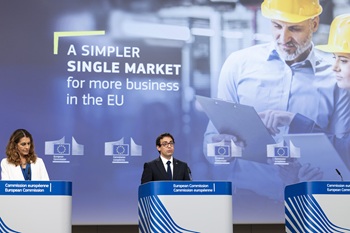
Single Market Strategy to boost EU services: Construction at its heart
On 21 May, the European Commission unveiled its new strategy “The Single Market: our European home market in an uncertain world”, laying out a detailed agenda to reduce barriers, improve implementation, and enhance competitiveness across the EU. The strategy identifies nine strategic pillars, ranging from simplification to digitalisation and enforcement — with a strong emphasis on unlocking the full potential of the EU services market.
While many actions reflect long-standing Commission priorities, the key novelty lies in a more sector-specific approach, aimed at delivering concrete results in areas most impacted by market fragmentation.
Construction identified as a priority sector
In a major development, the construction sector is explicitly recognised as a key focus area for structural reform. Despite its critical role — representing 11% of EU GDP — the construction services market remains highly fragmented, with only 1% of services exchanged across borders. The Commission acknowledges that persistent national regulatory barriers severely limit efficiency, competition, and the delivery of affordable, energy-efficient housing and infrastructure.
Stakeholders have raised long-standing concerns, which are now reflected in the Commission’s diagnosis:
A high number of regulated professions limits worker mobility;
Complex procedures for mutual recognition of professional qualifications and certificates;
Difficulties in demonstrating compliance in areas such as health and safety, environmental performance and energy efficiency;
Limited availability of cross-border insurance for professional liability;
Slow and fragmented authorisation and planning procedures for construction and renovation projects across Member States.
These barriers have a measurable cost: according to Commission estimates, reducing obstacles in construction services alone could increase EU gross value added by 0.5%.
A dedicated “Construction Services Act” by 2026
To tackle these challenges, the strategy outlines three flagship actions for the construction sector:
A Construction Services Act (Q4 2026): to facilitate cross-border access to construction and installation services by reducing regulatory and administrative fragmentation.
Joint action with Member States to simplify permitting and planning procedures (Q1 2026): within the broader European Affordable Housing Plan and the European Strategy for Housing Construction, this aims to accelerate housing supply.
Support for digitalisation in construction administration, including the integration of tools such as Building Information Modeling (BIM) in public procurement procedures.
FIEC will closely monitor the development of the Construction Services Act and contribute actively to ensure that the voice of the sector is heard. Construction is not only a pillar of the economy — it is also key to delivering Europe’s climate, digital, and social ambitions.
| Read more |