



FIEC’s answer to the consultation on a “Quality Jobs Act”
On 29 January, FIEC published its reply to the first-phase consultation of the European Social Partners on a Quality Jobs Act. In December, the European Commission published a Communication on a Quality Jobs Roadmap as well as a consultation document on a Quality Jobs Act. In the consultation, the European Commission is looking at possible areas for EU action and is consulting the Social Partners on the following:
Algorithmic management and AI at work.
Occupational Safety and Health: the consultation focuses on the review of the Workplace and Display Screen Equipment Directive to include telework and new tools, and on addressing psychosocial risks.
Subcontracting.
Just transitions.
Enforcement and the role of social partners.
FIEC is calling for more implementation, enforcement and monitoring of current legislations rather than new legislations. FIEC does not support a legislative approach and stresses the importance of keeping in mind the competitiveness and simplification objectives of the European Commission.
The Quality Jobs Act is expected for the last quarter of 2026.
| Read more |

FIEC provides input on “Fair Labour Mobility”
Responding to a Call for Evidence, on 2 February, FIEC sent to the European Commission its Position Paper on Fair Labour Mobility . In the document, FIEC insists that, except for very few very targeted pieces, no new legislation is required to make progress in this area.
In the first place, what is needed is better enforcement and simplification, to fight against unfair competition and illegal practices. This namely goes through the digitalisation of procedures and control tools. FIEC therefore encourages the roll-out of the European Social Security Pass (ESSPASS), the conclusion of the revision of the social security coordination rules and a cautious adoption and implementation of the e-declaration for posting workers. FIEC also points out the very important role played by national sectoral social ID cards – where they exist – to improve transparency.
Secondly, FIEC advocates for better information to be provided to employers, for them to navigate more easily in this complex legislative framework.
The European Labour Authority (ELA) has a clear role to play here, within its current mandate. FIEC indicates options to help tackle the shortage of (skilled) workers in construction, which includes the fair recruitment and integration of Third-Country Nationals (TCNs) in the EU construction market.
FInallyt, FIEC recalls that subcontracting in cross-border context is already covered by the Enforcement Directive and shall not be further regulated at the EU level. Transparency and control tools are better suited to make sure there are no abuses within a subcontracting chain.
The European Commission intends to present a Fair Labour Mobility package towards mid-2026.
| POSITION |

On the way to Intermat 2027
On 29 January, FIEC took part in a roundtable discussion organised in the framework of the launching of the INTERMAT fair that will take place in 2027 in Paris.
Under the theme of “Sustainability – Does Europe have the means to achieve its ambitions?”, Domenico Campogrande (FIEC), Carole Bachmann (ERA – European Rental Association) and Riccardo Viaggi (CECE – Committee for European Construction Equipment) exchanged on this topic presenting the views of different stakeholders in the supply chain.
For the contractors, FIEC Director General Domenico Campogrande highlighted:
- The challenges but also the many opportunities provided by the “sustainability” goals, among others as regards the improvement of the image of the sector.
- The significant initiatives at EU level for simplifying the current legislative framework, with the aim of combining sustainability and competitiveness.
- The need to foster a stronger cooperation between the various actors of the supply chain.
- The need to address the issue of labour shortages and skills gaps/mismatches.
| Read more |

European Construction Observatory enters new phase
The European Construction Observatory (ECO), under the supervision of the European Commission (DG GROW), has launched a new phase, strengthening its role as a central source of data and evidence for Europe’s construction ecosystem. Presented during a webinar organised by the European Commission on 27 January, the renewed observatory brings enhanced tools and analytical outputs tailored to industry and policymaking needs.
A key feature of this upgrade is the improved Data Mapper, which allows users to explore comparable EU-wide indicators on competitiveness, skills, innovation and investment in construction across all 27 Member States. This expanded evidence base supports informed decision-making by industry actors, public authorities and sector stakeholders alike.
The webinar also highlighted recently released analytical work, including the first Analytical Report on Skills in Construction, reflecting persistent challenges and emerging skills needs across the European construction workforce.
The ECO will continue to publish country fact sheets, policy briefings and trend analyses through 2026, providing valuable insights into structural developments shaping the construction sector.
24-25 March: Conference on Foundation Decarbonisation and Re-use
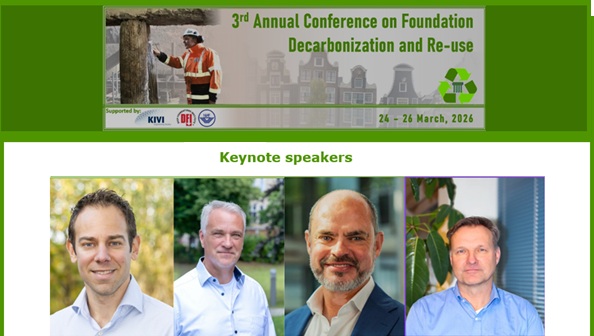
Decarbonisation in the construction industry is a key lever for significantly reducing CO2 emissions. Within the deep foundation segment, strategies increasingly focus on more efficient designs that reduce the volumes of concrete and steel used, as well as on the incorporation of materials with lower carbon footprints. Reusing existing foundations is another area of growing attention and is considered a highly sustainable option.
The 3rd edition of the Conference on Foundation Decarbonisation and Re-use will take place from 24 to 26 March 2026 in Amsterdam. The conference will explore a broad range of topics related to foundation decarbonisation and re-use, featuring dedicated focus sessions on inspection & testing, construction practices, and more.
The event is supported by EFFC (European Federation of Foundation Contractors), a FIEC Associate Member.
Access the conference details and the registration form via the below tab.
| Read more |