



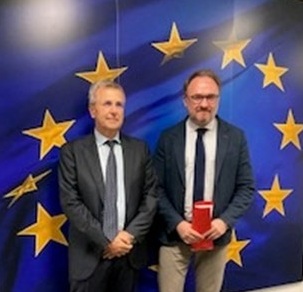
FIEC President presents housing priorities to Commissioner Jørgensen
On 15 September, FIEC President, Piero Petrucco, met EU Commissioner for Energy and Housing, Dan Jørgensen, to discuss housing issues. At this occasion, Petrucco described the specific nature of our mostly local and labour-intensive industry and highlighted three messages. Whereas the construction industry is a key player, at the heart of the EU Green Deal and the housing challenge, the shortage of skilled workers is severe and widespread.
Therefore, we need to improve the image and visibility of the sector, upskill and reskill the workforce, facilitate intra-EU mobility, namely through a better recognition of professional qualifications and attract Third-Country Nationals. Financing the missing housing units – i.e., more than 1 million annually in the EU – requires the mobilisation of both public and private investment. Petrucco pointed out a few best practices collected in the various Member States, with a focus on the Italian National Housing Plan, backed by the Cassa Depositi e Prestiti and which allowed the investment of about 4 billion euros to produce 18.000 social housing units, with both private and public participation. Another key priority is the digitalisation of building permit procedures. “Delay is cost!” stressed Petrucco. And currently, most of the times, these procedures are lengthy and cumbersome.
Against this backdrop, a fully digitalised submission and tracking procedure, via a one-stop-shop would altogether help streamline procedures, ensure that relevant regulations match with each other’s, improve productivity, reduce errors, delays and costs.
In the end, Petrucco insisted that, under the European Affordable Housing Plan, the concept of “vulnerable people” should be understood in a broad way, also covering the middle-class workers (e.g. teachers, nurses, firemen, policemen…).
Commissioner Jørgensen welcomed the input received and invited FIEC to further collaborate in the preparation of the Plan, which is expected to be published towards the end of 2025 or early 2026.
| FIEC POSITION |
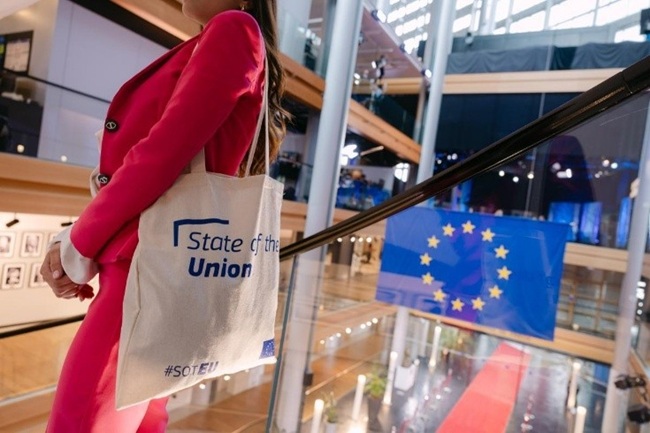
SOTEU – State of the Union 2025: What was in it for Construction?
On 10 September, the President of the European Commission, Ursula von der Leyen, delivered the first State of the Union (SOTEU) address of her new mandate in the European Parliament in Strasbourg.
After the European elections in summer 2024 and the new European Commission taking office in December, the address took stock of first achievements and presented the priorities for the year ahead. Security and the Russian war of aggression in Ukraine are still on top of the agendas, together with the fight against the housing crisis, and the ambitious simplification agenda to strengthen the competitiveness of European businesses.
President von der Leyen made clear that the reconstruction of Ukraine remains a key topic for the EU and its Member States. The European construction industry is a key interlocutor in these efforts, and we therefore support the idea of a Reparations Loan for Ukraine.
In terms of housing, the figures sadly speak for themselves. Prices are up by more than 20% since 2015, with building permits down by over 20% in five years. This is indeed more than a housing crisis, and difficulties in the housebuilding segment continue. Access to affordable, adequate, and energy-efficient housing is getting more and more difficult. Total costs have been identified as a main challenge, including the costs of construction, lengthy permitting procedures, and financing conditions. Addressing public and private financing schemes is key to making energy renovations and new construction affordable and accessible. We therefore welcome the announcement by President von der Leyen to swiftly deliver the European Affordable Housing Plan and to set up a first-ever EU Housing Summit. We will closely follow related developments.
Click on the below tab to read FIEC’s full article about SOTEU 2025.
| Read more |
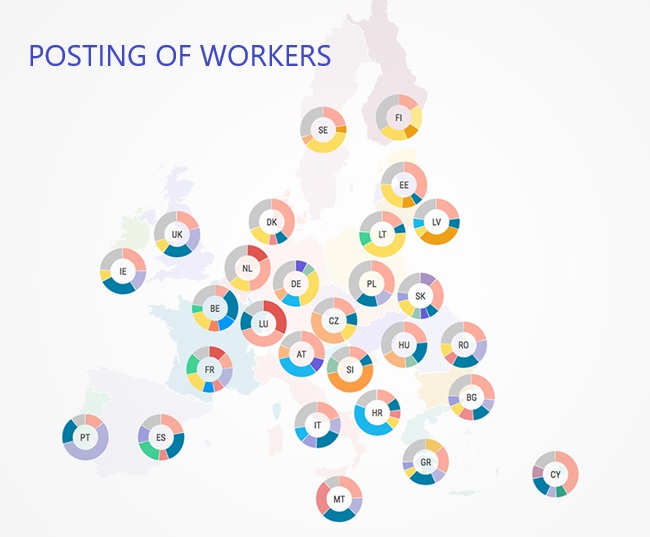
European Parliament adopts report on E-Declaration for the Posting of Workers
On 15 September, the IMCO and EMPL committees of the European Parliament jointly voted on the draft report on a “Public Interface connected to the Internal Market Information System for the Declaration of Posting of Workers” (E-declaration). The draft report was adopted, and the mandate entered into interinstitutional negotiations (with the EU Council and the European Commission – under a “trilogue”).
In short, the Parliament maintained the voluntary nature of the E-declaration, meaning that Member States can choose to use it or not. Moreover, it confirms that the information requested for posting a worker will be based on a common standard form. Member States can choose to ask for less information, but they cannot ask for more. However, the Parliament decided to provide for a detailed standard form, annexed to the text, with a quite long list of data points. In addition, it is made clear that enforcement authorities can impose other administrative requirements and request additional information when exercising control, compliance and enforcement functions, in accordance with national law and practice.
While FIEC advocated for an open list of requirements rather than a closed standard form, the solution proposed by the European Parliament seems to allow for quite some flexibility and aims at pushing for the list of requirements to be immediately annexed to the legislative text, rather than decided afterwards behind closed doors by the European Commission alone.
The European Parliament will now enter into negotiations with the Council – who adopted its General Approach in May – and the European Commission.
| FIEC POSITION |
EU Data Act
Joint Statement: European business associations urge strong and ambitious implementation
A new Statement was signed this week by the representatives of European companies, including small and medium-sized enterprises (SMEs) and small mid-caps, from across the digital sector and beyond. The aim is to jointly express firm support for the objectives of the EU Data Act. FIEC is among the signatories.
This aim of this is to call on the European Commission to uphold the regulation, resisting increasing pressure to undermine its core provisions.
The Data Act is a horizontal framework designed to unlock access to industrial and user-generated data across the European economy. It gives SMEs the ability to port such data to third parties, shields them from unfair contractual terms, and ensures that data sharing happens on fair, reasonable, and non-discriminatory terms. The Act also requires cloud providers to eliminate lock-in practices and enable switching through open standards. This is an important step toward leveling the playing field and enabling innovation across sectors for companies of all sizes, and particularly SMEs.
Big Tech industry groups are calling for changes such as delayed enforcement, looser definitions of interoperability, and reliance on global standards without adequate guarantees of fairness. These lobbying efforts, at both EU and national level, risk weakening the ability of the Data Act to foster a fairer, more open, and more competitive European data economy. The latter is essential to unleash the innovative potential of SMEs and small mid-caps. To deliver real change, the Data Act must be implemented fully and faithfully to end vendor lock-in and open up Europe’s cloud and data markets to genuine competition.
The signatories acknowledge the importance of regulatory clarity and effectiveness, and urge the European Commission to ensure that any regulatory simplification does not undermine the core objectives of the Data Act: bringing openness and balance to the digital economy, and promoting the competitiveness of European businesses. Any reinterpretation, delay, or softening of the Data Act’s key provisions risks reinforcing the barriers it was designed to eliminate.
Europe’s data economy depends on the combined strengths of all European companies. A strong implementation of the Data Act can ensure a competitive and sovereign Single Market that supports innovation across all actors.
We therefore urge the European Commission to stand firm and ensure a full and robust enforcement of the regulation.
| FULL STATEMENT |
Public Procurement Reform: Non-legislative own-initiative report (INI) by the European Parliament
On 9 September, the European Parliament adopted its non-legislative own-initiative report (INI) on public procurement (2024/2103(INI)) with 432 votes in favour, 95 against and 124 abstentions, following the adoption in the IMCO Committee in July 2025.
An INI report is a political Resolution: it does not directly amend EU law, but it signals the Parliament’s priorities to the other EU institutions and guides the forthcoming revision of the Public Procurement Directives.
FIEC welcomes the clear signal sent against the practice of “lowest price only”. The report brings back to the forefront the Most Economically Advantageous Tender (MEAT) and life-cycle costing, ensuring that decisions reflect performance, sustainability, maintenance and risk, rather than the purchase price alone. FIEC also values the spirit of realism reflected in the text, which prioritises flexibility and adaptable criteria that can fit different national contexts, rather than uniform and overly restrictive obligations. This evolution is essential to deliver more resilient projects, reduce hidden costs and ensure better use of taxpayers’ money.
Another major step forward is the stronger stance against abnormally low tenders, with clearer obligations and a harmonised methodology. This will ensure fairer competition, higher quality of execution and fewer distortions that undermine responsible companies.
On the international scene, the Parliament calls for the full use of EU instruments to guarantee a level playing field: the International Procurement Instrument (IPI) and the Foreign Subsidies Regulation (FSR) should be deployed to counter unfair practices and encourage reciprocity in market access. This approach will help secure supply chains and strengthen the European industrial base.
However FIEC regrets that the report asks the European Commission to introduce at the European level a mandatory division into lots. FIEC strongly believes that while contracting authorities should continue to properly assess whether it is appropriate to divide contracts into lots, they must preserve the freedom to determine autonomously the number, size and scope of those lots, without being subject to administrative or judicial interference. The wording of the current provisions on this topic (Art.46 of Directive 2014/24/EU) is the adequate framework to achieve this goal and should be maintained. This was underlined in a joint letter with the EIC addressed the MEPs.
The report also contains several other issues of concern, such as, for example, the in-house procurement, subcontracting, grounds for exclusion, etc. which will be discuused and addressed by FIEC.
What’s next? The ball is now in the European Commission’s court, which must present a revised directive proposal (expected end of 2025–2026), taking into account this parliamentary roadmap.
Eurofound publishes the first findings of the European Working Conditions Survey 2024
Eurofound published the first findings of the European Working Conditions Survey 2024. This survey, done on a regular basis since 1990, collected the inputs of 36.644 workers across 35 countries.
The study looks at 7 dimensions of job quality: physical environment, social environment, working time quality, work intensity, skills and discretion, prospects and earning. As an example, the study finds out that the quality of physical work has been improving since 2010 but the exposure to high temperature and chemical contact has increased.
52% of workers in the construction sector reported “above average exposure to high temperatures a quarter or more of the time”. Regarding organisational participation, it finds out that half of employees in construction report being able to influence decision that are important for their work always, or most of the time.
The full report is expected for the beginning of 2026.
| Read more |

“La multi ani”, ARACO turning 35!
2025 will undoubtedly remain a year of celebration. FIEC will mark its 120th anniversary and our Romanian member federation, ARACO, celebrates its 35 years of construction ‘life’: a considerable voice for the construction sector in Romania and a promoter of strengthening the global competitiveness of the European construction industry.
To congratulate on this very special recurrence and to highlight the importance of working together toward common goals, FIEC Director General, Domenico Campogrande, shared a message published by the specialised construction magazine “Revista Constructiilor“.
“For the 35 years of ARACO, I would like to extend my warmest congratulations, both personally and on behalf of all FIEC members. Reaching such an important milestone is clear evidence of ARACO’s enduring relevance, its solid membership base and its recognized role as the leading voice for the construction sector in Romania“, said Campogrande.
About ARACO
ARACO became a member of FIEC in June 1995, demonstrating its commitment to aligning itself with the European integration process – not only politically, but also at a sectoral level – in order to fully benefit from these developments.
Today, Laurentiu Plosceanu, President of ARACO, also holds the position of FIEC Vice-President for Communication & Enlargement and represents Bulgaria, the Czech Republic, Romania and Slovakia within the FIEC Steering Committee.
“Being in Brussels does not only mean physical proximity to the EU institutions. It also means the ability to monitor and influence the EU decision-making process. Let’s not forget that approximately 75% of national legislation comes directly or indirectly from European regulations” – highlighted Campogrande in his message.
We count on ARACO to continue its valuable contribution to FIEC as it has done in the last 30 years of membership.