




FIEC calls for procurement rules that work for construction
On 9 September, the European Commission presented its Public Procurement Act proposal, which would replace the three existing Procurement Directives with a single Regulation, and aims to offer a major opportunity to reduce paperwork and reward quality, provided the new rules work in practice. The proposal now goes to the European Parliament and the EU Council.
FIEC supports simpler procedures, fair competition and greater scope for innovation.
FIEC continues to favour a framework based on Directives, allowing national flexibility and taking account of construction needs. The proposed Regulation requires careful assessment, particularly where it interacts with national administrative and contract law. Its success must be measured by a real reduction in administrative work for companies and public buyers.
Digitalisation offers a major opportunity. FIEC strongly supports a single European portal, connected systems and reusable electronic business credentials. Submitting information once and reusing it would reduce paperwork and make contracts across borders easier to access. Implementation will require functioning systems, protection of confidential information and practical support for small and medium-sized enterprises (SMEs).
FIEC also sees positive directions in better market consultation, alternative technical solutions and the rejection of unjustified abnormally low tenders. Its assessment with member federations will examine subcontracting, exclusion rules and awards to publicly controlled entities. Transparent competition, balanced risk allocation and workable price-adjustment mechanisms remain essential for delivering buildings and infrastructure.
With the experts from our member federations we will now examine in the detail the proposal of the Commission and take the appropriate initiatives, in order to ensure that the final outcome effectively delivers a more simple and efficient framework.
| PRESS RELEASE |
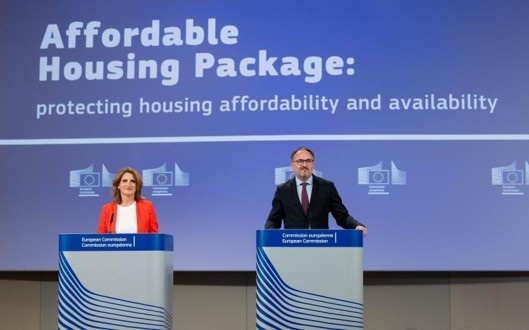
“Affordable Housing Act” combines local action with support for more homes
On 9 September, the European Commission presented its Affordable Housing Act package: a proposed regulation and a non-binding recommendation to increase housing supply. It follows the European Affordable Housing Plan adopted in December 2025. The Regulation still requires approval by the European Parliament and the EU Council.
The proposal would establish a common framework for identifying areas under housing stress and assessing restrictions intended to protect housing affordability. These include restrictions on short-term rentals outside a host’s primary residence and on property acquired or used for purposes other than a primary residence. Authorities would need evidence to justify measures, which must be proportionate, transparent and regularly reviewed.
The accompanying Recommendation focuses on building and renovating more homes. It encourages local housing acceleration plans, faster and digital permitting, better use of existing buildings and land, and modern construction methods. It also connects housing delivery with transport and essential infrastructure.
This focus reflects priorities already advocated by FIEC: simpler permitting, investment, innovation and construction skills. For the sector, the next step is to turn these priorities into viable projects and remove the practical obstacles that delay affordable homes.
Click here to read FIEC’s housing priorities.
| PROPOSED REGULATION |

New study of the European Employers’ Institute on the “Right to Training”
The European Employers’ Institute (EEI), of which FIEC is one of the founding members, published a new study: “The Right to Training in the European Union Law: a legal study on the constitutional limits of EU action under Article 166(4) TFEU“.
This study looks at the limits of the EU action in the field of vocational training and the legal implications of introducing a binding training obligation for employers at EU-level. The study also examines the diversity of national approaches in the Member States. It concludes that the current EU Treaty framework does not provide a legal basis for introducing a general binding training obligation for employers.
| Read more |

Grete Aspelund elected President of FIEC’s Norwegian member federation (EBA)
Grete Aspelund has been elected President of EBA (Entreprenørforeningen – Bygg og Anlegg), the Norwegian Contractors Association.
She has served as Vice-President of EBA for the past two years and brings extensive leadership experience from the construction, infrastructure and engineering consultancy sectors. She is a former CEO of Sweco Norway and has headed NCC Industry since 2022. She also served as FIEC Vice-President from 2024 to 2026, with responsibility for environmental issues.
In her new role as President, Grete Aspelund emphasises the importance of a strong and united construction industry in addressing major societal challenges: “I am grateful for the confidence placed in me and look forward to leading EBA’s Board. Contractors build and maintain the infrastructure, buildings and facilities that society depends on. At the same time, parts of our industry are facing very challenging market conditions, a growing need for skilled workers and increasing requirements related to sustainability, safety and responsible business practices. This makes a strong industry association even more important. We need to stand together and be clear about what is required to deliver the projects Norway needs.”
FIEC wishes Grete every success and looks forward to continuing its long-standing, constructive cooperation with EBA under her leadership.
| ABOUT EBA |

Jimmy Bengtsson elected President of NHO Byggenæringen
The other Norwegian Member Federation of FIEC, NHO Byggenæringen – the Federation of Norwegian Construction Industries – has also elected its new President, namely Jimmy Bengtsson. He is the CEO of Veidekke in Norway and brings extensive leadership experience from the construction industry. He has also held several key positions in industry organisations, including serving as former President of EBA – the Norwegian Contractors’ Association.
NHO Byggenæringen represents companies across the entire Norwegian construction value chain, from contractors, skilled trades and building material producers to property developers and other construction-related businesses.
As President, Bengtsson will lead the Board of an organisation representing a large and diverse industry with an important role in Norway’s economy and the development of society. “I am grateful for the confidence placed in me and look forward to leading the Board of NHO Byggenæringen. The construction industry is fundamental to the development of Norway. We build the homes, workplaces and infrastructure society needs, and we maintain and develop what has already been built,” says Bengtsson.
He believes that bringing the different parts of the construction industry together will be particularly important in the years ahead.
“Many companies are facing a demanding market, while the industry also needs to become more productive and deliver on the green and digital transition. We need predictable framework conditions, sufficient activity and access to skilled workers. By standing together around common priorities, we can strengthen both the competitiveness of our companies and the industry’s contribution to Norwegian society,” adds Bengtsson.
| ABOUT NHO |

“Construction Blueprint 2” launches European Skills Observatory Survey
As part of the EU-funded project, Construction Blueprint 2, a European-wide survey has been launched inviting construction companies across Europe to share their perspective on the skills needed to successfully navigate the sector’s green and digital transitions.
The survey aims to identify current and emerging skills needs in the construction sector, with a particular focus on green, sustainable construction, energy efficiency, digitalisation as well as transversal skills. The findings will feed directly the skills observatory tool, which was developed for observing and monitoring of skills needs in the construction sector.
The survey covers companies from 12 countries: Belgium, Bulgaria, France, Germany, Greece, Ireland, Italy, Luxembourg, Poland, Romania, Slovenia and Spain. The questionnaire takes around 10 minutes to complete and is fully anonymous.
Click on the below tab to take part in the survey and help shape the sector’s future skills strategy.
| SURVEY |
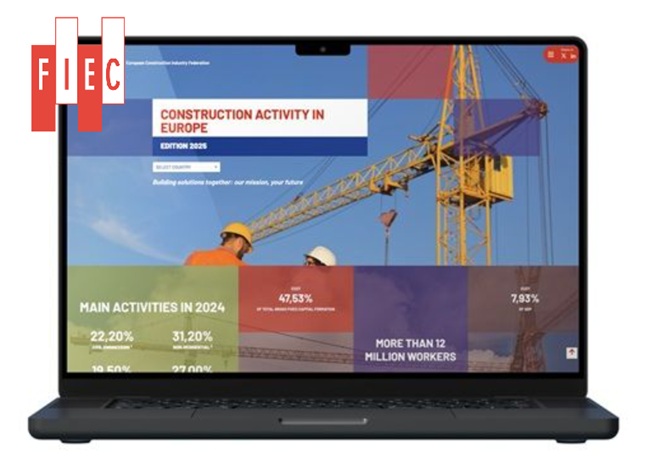
FIEC Statistical Report points to a fragile construction recovery
On 7 September, the Statistical Office of the EU (Eurostat) published its update offering a timely reason to revisit the 2026 edition of the FIEC Statistical Report and the conditions needed for a sustained recovery. Our report provides a detailed view of a sector emerging from two difficult years. Its European overview and national chapters bring together results for 2025 and forecasts for 2026, helping companies and policymakers understand how conditions differ across markets and construction activities.
FIEC reports a further fall in real construction investment in 2025 and forecasts a moderate return to growth in 2026. Civil engineering remains a source of strength, supported by infrastructure investment, while building activity is expected to improve gradually. The report nevertheless stresses that recovery depends on financing conditions, public investment, costs and the ability to bring projects forward.
Eurostat’s news item provides a more recent snapshot. EU total market production edged down in June, with construction among the main sources of weakness. Construction production fell by 1.0% compared with May. The detailed construction release also shows that output was only slightly above June 2025, with building construction still weaker than civil engineering. These indicators describe different aspects of the market. FIEC’s figures concern annual construction investment, with 2026 still a forecast. Eurostat measures production already recorded over a single month, using adjusted data. June’s decline cannot on its own confirm or invalidate the annual forecast, but it shows that the path to recovery remains uneven. The distinction matters when using the figures in business planning or policy discussions.
Other Eurostat construction data are available here.
| STATISTICAL REPORT |
East Finland contractors explore Belgian construction innovation
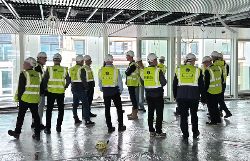
A delegation of contractors from Eastern Finland recently travelled to Belgium for a study visit aimed, among others, at gaining insights into European construction best practices.
In addition to meetings with EU institutions, FIEC, with the support of its Belgian member federation Embuild, organised a visit to a major construction site in Brussels: the deep renovation of the headquarters of Constructiv, Belgium’s sectoral fund for training, health and safety, and prevention in the construction industry.
The ambitious 6,000 m² renovation project showcases some of the most advanced solutions currently available in the fields of energy efficiency and sustainability. By integrating cutting-edge technologies and innovative construction methods, it provides a valuable example of how the built environment can contribute to Europe’s climate and resource-efficiency objectives.
Such exchanges offer a unique opportunity to share knowledge and learn from successful projects across borders. They are an important source of inspiration for the future development of construction activities throughout the European Union and help promote the dissemination of best practices across the sector.