





Lubomir Katchamakov elected new President of CICA
For the term 2026-2028, Lubomir Katchamakov (BG), President of the Bulgarian Construction Chamber (BCC, FIEC’s member federation), was elected new President of CICA (World Construction Association). The election took place during CICA’s Autumn General Assembly, held in Paris on 3 November.
At the head of a new CICA Board
The new CICA Board brings together representatives from across its international network. Three CICA Vice-Presidents were elected: Giuseppe Angelucci (El Salvador), Ali Al Sanafi (Iraq) and Philippe Dessoy (Belgium). Michel Démarre (France) was confirmed as Treasurer. Philippe Dessoy formerly served as CICA President and as member of the EIC Board. In addition to his new role within the CICA Board, he has been appointed CICA Ambassador for External Relations, in recognition of his commitment to expanding and strengthening the organisation’s international network, particularly in Africa and the Arab world.
FIEC warmly congratulates Lubomir Katchamakov, Philippe Dessoy and all the newly elected and appointed members of the CICA leadership team.
Continuing our partnership
Although construction is primarily a local activity, many of the challenges facing the sector are shared worldwide. These include improving the attractiveness of the construction sector, addressing the shortage of affordable housing and ensuring adequate financing for infrastructure investment. In this context, international cooperation, the exchange of experiences and the sharing of best practices are essential.
| ABOUT CICA |
Industrial Accelerator Act: FIEC finalises its position
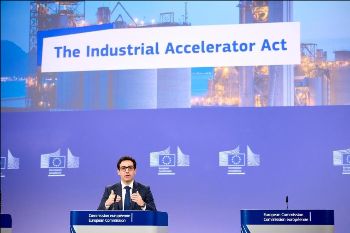
FIEC finalised its position on the proposed Industrial Accelerator Act (IAA), which would introduce low-carbon and, where applicable, EU-origin requirements through public procurement and public support schemes.
FIEC’s recommendations aim to support industrial decarbonisation while keeping implementation practical for construction companies. FIEC calls for construction binders, including cement and equivalent binding technologies, to replace concrete and mortar in the quantitative material requirements. It also stresses the need for a level playing field between construction products and technologies, with carbon performance assessed across the works and technical performance, durability and design freedom preserved.
FIEC advocates long-term price signals that encourage investment in low-carbon technologies, alongside dedicated funding for research, innovation and the market uptake of sustainable materials. Any cost premiums for low-carbon industrial products should be transparently earmarked for decarbonisation investment.
FIEC also calls for the IAA to build on existing rules supporting low-carbon construction. The Construction Products Regulation (CPR) should remain the single technical reference for construction products, with clear definitions, reusable product information and practical evidence requirements. Contractors should be able to rely, with due care, on information provided by manufacturers and suppliers.
Additional compliance costs must be recognised and funded so that housing and infrastructure investment can be maintained. A realistic timetable, requirements reflecting material availability and manageable administrative procedures are essential, particularly for SMEs.
These priorities will guide FIEC’s assessment of parliamentary amendments and its discussions with EU policymakers as negotiations progress.
European Commission’s 2027 Work Programme:
What it means for construction
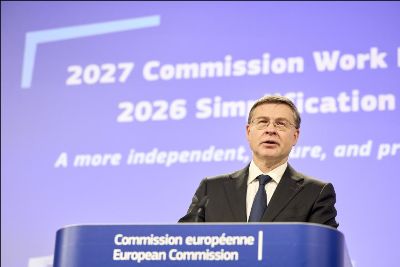
On 4 November 2026, the European Commission adopted its 2027 Work Programme, entitled “European Union – standing up for one another”. Presented by Executive Vice-President Valdis Dombrovskis and EU Commissioner Maroš Šefčovič, the programme sets out the Commission’s legislative and policy priorities for the year ahead, with a strong focus on European competitiveness, simplification, investment and strategic autonomy.
The Commission highlights the need to accelerate the implementation of existing proposals while introducing new initiatives to address Europe’s economic, social and environmental challenges. It estimates that its 12 Omnibus packages and other simplification measures could generate €22.3 billion in annual recurring administrative cost savings once fully implemented.
For the construction sector, the Work Programme contains a number of relevant initiatives and pending legislative proposals concerning the Single Market, permitting, digitalisation, energy, housing, skills, environmental legislation, public procurement and infrastructure investment.
The following overview provides the construction-related items that FIEC identified in the Commission’s Work Programme and its annexes.
New initiatives: What to expect in 2027
- Single Market – Preventing market segmentation by suppliers (Q3 2027):
- Permitting acceleration (Q3 2027)
- Single Market barriers prevention (Q3 2027)
- Digital transformation package, simplification and copyright (Q2 2027)
- Post-2030 energy framework and simplification package (Q1 2027)
- Housing simplification package (Q2 2027)
- Skills Guarantee (Q3 2027)
- European Water Initiative (Q2 2027)
- European Heatwave Plan (Q2 2027)
- Review of nature protection Directives, including Birds, Habitats and Natura 2000 (Q3 2027)
The Commission plans a legislative or non-legislative review of the nature protection framework, including the Birds and Habitats Directives and Natura 2000. FIEC will follow this initiative closely, particularly in view of its potential implications for construction projects, environmental assessments and permitting procedures.
Priority pending proposals
In addition to the new initiatives, the Commission identifies several pending legislative proposals as priorities for rapid agreement by the European Parliament and Council. The following files are particularly relevant to FIEC, in the order in which they appear in Annex II.
- European Product Act (standardisation)
- Public Procurement Act
- Emissions Trading System (ETS) Review
- Omnibus VIII on Environmental Legislation
- 2028–2034 Multiannual Financial Framework (MFF)
The Commission wants the co-legislators to reach an agreement on the next long-term EU budget by the end of 2026. Of particular relevance to construction is the proposed €81.4 billion Connecting Europe Facility (CEF) for 2028–2034, which would support investment in European transport and energy infrastructure.
Planned withdrawals
Finally, Annex III identifies pending legislative proposals that the Commission intends to withdraw within six months. Two are particularly relevant to FIEC.
- Green Claims Directive
- Late Payment Regulation
The Commission also intends to withdraw its 2023 proposal for a Regulation on combating late payment in commercial transactions. The file has been pending for more than three years, with a sizeable number of Member States opposing further work on the proposal.
The 2027 Work Programme confirms that simplification and competitiveness will remain central to the Commission’s agenda. The Commission also announces a “Pact against Gold-Plating“, intended to prevent Member States from adding unnecessary complexity when transposing or implementing EU rules.
The programme further reaffirms the EU’s commitment to supporting Ukraine, notably by strengthening its critical infrastructure and revitalising the EU–Ukraine Solidarity Lanes.
2027 will also mark the tenth anniversary of the European Pillar of Social Rights, which the Commission intends to celebrate with a dedicated summit.
FIEC will closely monitor the initiatives and pending proposals outlined in the Work Programme, engaging with the European institutions to ensure that new measures genuinely simplify the regulatory environment, support investment and strengthen the competitiveness of the European construction industry, rather than creating additional administrative and regulatory burdens.
| Read more |

ELA: Meeting of the “European Platform tackling undeclared work”
On 3 and 4 November, FIEC participated in the 21st meeting of the “European Platform tackling undeclared work” at the European Labour Authority (ELA) in Bratislava.
The meeting started with some updates from the European Commission on relevant files such as the Fair Labour Mobility Package and the evaluation of the Employers’ Sanctions Directive. Participants also discussed the planning of ELA activities on undeclared work for 2027 and 2028, with a focus on platform work and self-employement. The thematic session of the meeting was about tackling undeclared work in subcontracting.
Several Member States’ authority presented their national legislation and practices on subcontracting, due diligence and liability. Social Partners also presented some practical examples, including in the construction sector.
| Read more |
European Commission “Simplification Report 2026”
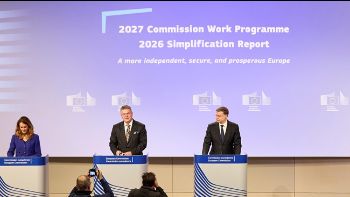
Last week, the European Commission issued its 2nd annual overview report on Simplification, Implementation and Enforcement. During this mandate, 12 Omnibus packages and further simplification measures have been published already.
However, the European Commission can only adopt the legislative proposals and therefore stresses that the savings depend on the European Parliament and the Member States in the EU Council agreeing swiftly, and without watering them down.
The report links simplification directly to faster permitting. Omnibus VIII on environmental legislation, which includes the Regulation on speeding up environmental assessments, is expected to bring about EUR 1 billion in cost savings.
FIEC supports the simplification priority to maintain and support the competitiveness of businesses in the EU. Reducing administrative burdens and streamlining the legislative framework for more efficiency is key to restoring a business-friendly climate that attracts investments and supports job creation. FIEC will continue to engage with the institutions and its national member federations to ensure that proposals are effective to deliver both on the broad simplification priority and the EU affordable housing objective in particular.
| FIEC ARTICLE |
“DESOCO 3” Workshop: Innovation and AI in construction
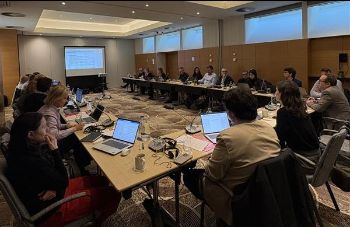
On 4-5 November, social dialogue partners FIEC and the European Federation of Building and Woodworkers (EFBWW) held their third thematic workshop on Innovation and AI under DESOCO 3, the EU co-funded project that aims to strengthen social dialogue and address key labour market challenges in the European construction industry.
Employers’ and workers’ representatives discussed digitalisation, AI and robotics and their links with occupational safety and health (OSH), modular and off-site construction, and the training and skills the sector will need.
Participants also visited the Buildwise Innovation Centre in Limelette (BE), where they toured the Experience Centre and its laboratories, including acoustics, chemistry, structural testing, and weather and flood stations.
Click here to learn more on the project and available resources.

European Commission unveils “Education and Skills Package” with new VET Strategy
On 5 November, Executive Vice-President Roxana Mînzatu, responsible for Jobs and Skills, presented the European Commission’s new Education and Skills Package. The aim of the proposals is to reverse the decline in basic skills, make digital and AI tools work for learning, tackle teacher shortages and make Vocational Education and Training (VET) more agile and better connected to labour market needs.
The package contains three main proposals: a European strategy on VET for 2026-2030, a draft Council Recommendation on making the teaching profession more attractive, and a draft EU Council Recommendation on reversing the decline in basic skills.
For construction, the key part is the new European VET Strategy setting out three new initiatives. From 2027, a pilot European Sectoral Training Accelerator will offer short training modules developed with industry, which training providers can add to national programmes. From 2028, companies and VET schools will be able to set up new training centres together, to help businesses, especially SMEs, find skilled workers. An EU mobility marketplace will also help apprentices and VET learners find training abroad.
The Council is now invited to examine and adopt the two draft Recommendations. Implementation will start at the European Education and Skills Summit on 20 November.
| Read more |