




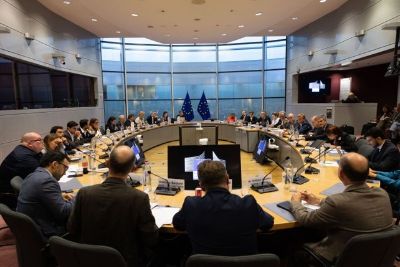
FIEC joins dialogue with EU Commissioner Jørgensen on housing supply
On 14 October 2026, FIEC, represented by Louis Amory, Managing Director of “Maisons Blavier”, intervened in the Implementation Dialogue on Housing Supply with Dan Jørgensen, European Commissioner for Energy and Housing, .
The exchange highlighted common concerns about permits, administrative procedures and the reuse of waste as construction materials. Participants stressed the need for rapid, practical measures in response to the difficulties facing the sector.
These discussions support FIEC’s calls for better coordinated permits, less duplication and workable material reuse.
The dialogue will help inform the European Commission’s work on housing simplification. FIEC will follow the Commission’s summary and the next steps towards the Housing Simplification Package, expected in 2027.
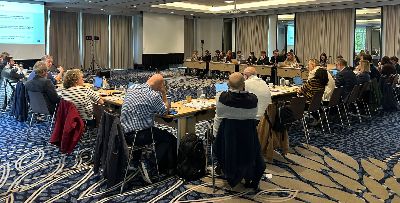
EU Social Dialogue Committee for Construction: Meeting of Working Group “Employment”
On 14 October, FIEC and the European Federation of Building and Woodworkers (EFBWW) representatives met in Brussels for the Working Group “Employment” of the European Social Dialogue Committee for Construction.
Participants exchanged with European Commission experts on two key proposals for our sector: the “Fair Labour Mobility” package and the “Public Procurement Act“. The meeting was also the occasion to discuss upcoming initiatives such as the “Quality Jobs Act” and the “Construction Services Act“, for which FIEC and EFBWW have several joint initiatives.
Finally, FIEC and EFBWW discussed the state-of-play of the e-declaration and the revision of the regulation on the social security coordination, as well as on the activities carried out under EU-funded projects.
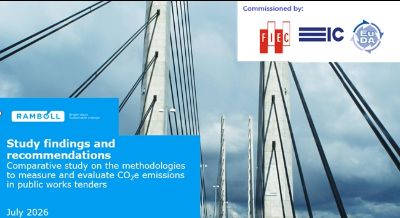
CO₂ emissions assessment in public works:
FIEC, EIC and EuDA call for a common approach
FIEC, together with EIC and EuDA, published a comparative study of CO₂ emissions assessment frameworks used in public works procurement across Europe.
The study highlights differences in methodologies and requirements, calling for greater consistency, proportionality and flexibility to reflect the specificities of different projects and procurement models.
The three organisations advocate a practical European approach that supports carbon reduction, encourages innovation and ensures a level playing field for contractors.
| PRESS RELEASE |
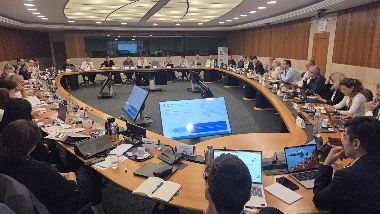
Belgium’s fight against undeclared work: Construction proves compliance works
On 13 and 14 October, FIEC attended a study visit in Brussels, organised by ELA (European Labour Authority) and the Belgian SIIS (Social Investigation and Information Service).
The event, gathering labour inspectors from all over the EU, was aiming at presenting the strategy and tools used by the Belgian labour authorities to fight against undeclared work.
With an integrated approach based on risk targeting, data-driven enforcement, digital tools and in collaboration with the social partners, as well via an enhanced cooperation between labour inspection, social security, tax, police and judicial authorities, Belgium has developed one of the most advanced strategies for tackling undeclared work.
As part of this study visit, unannounced inspections took place on 2 construction worksites and no particular irregularities were found. They showed that construction is also about genuine companies, as well as clean and legal practices. Even in complex environments with different companies interacting with each other and with workers from many different horizons.
FIEC brings construction priorities to EU Parliament Procurement Roundtable
FIEC took part in a stakeholder roundtable on the proposed Public Procurement Act at the European Parliament on 15 October. Hosted by shadow rapporteur MEP Jeannette Baljeu (Renew Europe/FR), the meeting brought together business organisations and public buyer networks to discuss European preference, quality criteria and practical improvements to the reform.
Gerrit-Jan van de Pol, Chair of the FIEC “Working Group on Public Procurement”, brought the experience of construction companies to the discussion. He stressed that the reform should help public buyers and contractors achieve better results while keeping participation manageable.
Quality that makes a difference
FIEC called for quality criteria that genuinely distinguish offers. Where all bidders receive similar quality scores, price remains decisive and additional paperwork brings little benefit. The discussion highlighted the need to design evaluation methods that reward real improvements in delivery.
European preference that works in practice
Clearer access rules must come with reliable digital support and proportionate evidence requirements. Construction companies use many materials and products they do not manufacture themselves. Origin checks therefore need to reflect the information available from suppliers and the realities of construction supply chains. FIEC emphasised that the Commission’s Article 71 tool must be usable when the new rules start applying.
Frameworks that allow learning between projects
FIEC’s concrete contribution concerned the duration of framework agreements under Article 103. Longer arrangements can allow buyers and contractors to apply lessons from one project to the next, improve productivity and invest in teams and specialised equipment. Shorter frameworks risk limiting that learning cycle and bringing forward another costly procurement exercise.
The exchange showed shared concerns about digital readiness and administrative burdens, alongside different views on minimum quality weightings and buyer flexibility. FIEC continues to favour a directive and will use members’ contributions to refine its position and develop concrete amendments for the parliamentary debate.
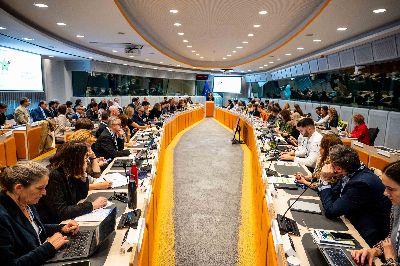
Launch of EU-OSHA new healthy workplaces campaign
On 13 October, FIEC attended the launch event of the new EU-OSHA Healthy Workplaces Campaign for 2026-2028: “Together for mental health at work“.
The European Commission Executive Vice-President for Social Rights and Skills, Quality Jobs and Preparedness, Roxana Minzatu, opened the conference. She stressed that mental health is a priority in the EU’s approach to health and safety at work and a key component of quality jobs. Representatives of the European Parliament, companies, trade unions and the European Commission exchanged on the importance of the topics, on what need to be done and on good practices.
EU-OSHA campaign will focus on five priority areas: psychosocial risk assessment and management; harassment, sexual harassment and violence; physical risks and mental health; psychosocial risks in the health and social care sector; and supporting mental health at work.
FIEC is an official partner of the campaign and is looking forward to contributing to it!
| Read more |
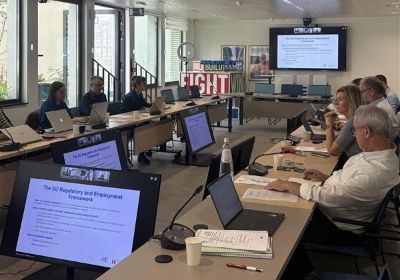
CLEARSITE holds first Steering Committee meeting in Brussels
On 13 October, the EU-funded project CLEARSITE (Construction Legal Enforcement And Resources to Support the Integration and Treatment of TCNs in Europe) held its first Steering Committee meeting in Brussels, hosted by project coordinator European Federation of Building and Woodworkers (EFBWW).
Launched in September, this two-year project brings together the EU-level construction social partners, EFBWW and FIEC. It aims to promote the fair recruitment and integration of Third-Country Nationals (TCNs) in the European construction sector, building on the recommendations of former FELM project.
The main deliverable will be a set of joint guidelines, based on desk research, four case studies and site visits in several EU countries.
The meeting allowed participants to align on the project’s approach, laying the groundwork for its successful implementation.
Learn more about the project and expected guidelines here.
| READ NEWS |

European Employment and Social Outlook 2026:
What it means for construction
The European Commission published the 2026 European Employment and Social Outlook, which this year focuses on job quality: earnings, job security and working time. Construction has been one of the EU’s job engines. Employment in the sector grew by 1.6% a year between 2019 and 2025, driven by housing demand, the green transition and public infrastructure. The report warns, however, that the current energy shock could stall this growth.
Two findings stand out for our sector. First, building electricians and plumbers are among the EU’s top ten shortage occupations, and eight of those ten require a vocational qualification, which shows how important VET (Vocational and Educational Training) is for current labour market needs. Second, job security has improved: since 2014, involuntary temporary work among mining and construction workers has fallen by 5.9 percentage points, about three times the EU average.
| READ REPORT |