





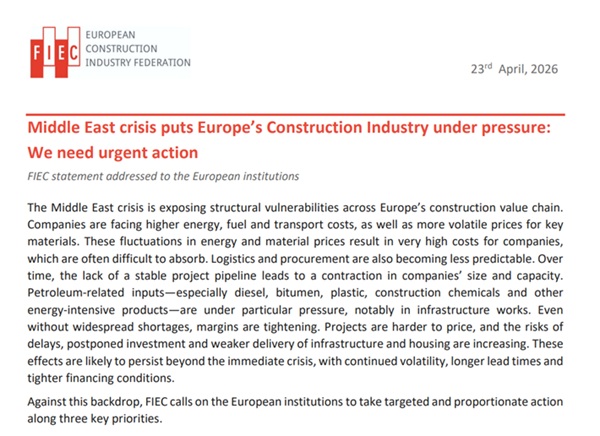
Middle East crisis puts Europe’s Construction Industry under pressure: We need urgent action
FIEC published a statement for raising awareness about the growing impact of the Middle East crisis on Europe’s construction sector, with rising costs, increased volatility and reduced predictability for projects.
FIEC calls on EU institutions and Member States to act swiftly to safeguard competitiveness, secure access to critical inputs and ensure more workable contractual frameworks to manage sudden shocks.
A stable and predictable framework remains essential to sustain investment and deliver on infrastructure, housing and the green and digital transitions.
| STATEMENT |
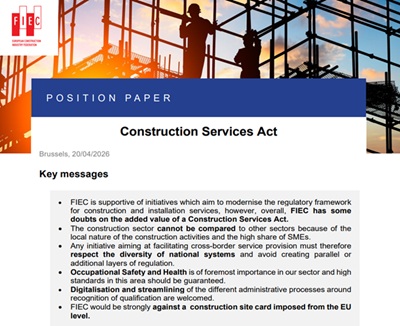
FIEC’s position on the upcoming Construction Services Act
FIEC supports initiatives which aim to modernise the regulatory framework for construction and installation services. However, overall, FIEC has some doubts on the added value of a Construction Services Act. First, FIEC recalls that the construction sector cannot be compared to other sectors because of the local nature of the construction activities, as well as the high share of SMEs.While EU initiatives can facilitate the sharing of information and improve mutual recognition of qualification and certification, it should never lower national standards, especially on Occupational Safety and Health.
FIEC is also strongly against a construction site card imposed from the EU level, as highlighted by the European Social Partners FIEC and the European Federation of Building and Wood Workers (EFBWW) in their joint EU-funded project, SIDE-CIC.
Regarding insurance policies, FIEC is not in favour of European harmonisation but would be in favour of any initiative regarding the recognition of foreign policies and the additional costs faced by European companies wishing to take out insurance in the receiving country.
| POSITION |
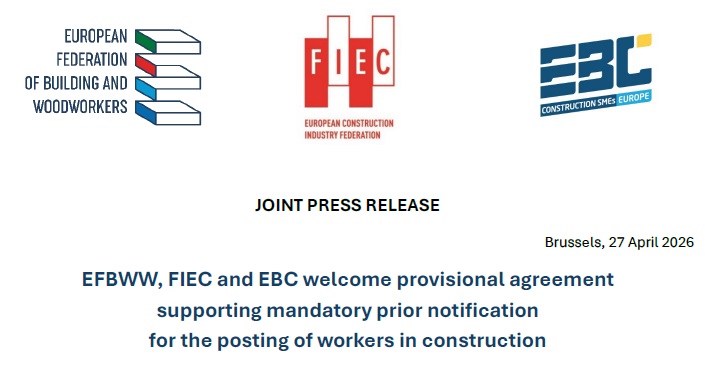
FIEC, EFBWW and EBC welcome provisional agreement on social security
At a trilogue meeting on 22nd April, the Cypriot Presidency managed to get a provisional agreement on the revision of the coordination of social security across the EU. This outcome is a significant breakthrough after 10 years of negotiations on this heavy file.
For the construction industry this is a huge and successful milestone as the EU co-legislators recognised the specificities of the sector and took into account our long-lasting request to keep a mandatory prior notification for posting workers as of day one. The goal is to tackle risks of abuses and frauds in the sector.
This very positive development must now be formally endorsed by both the European Parliament and the Council. FIEC, EFBWW, the EU sectroal social partners for the construction industry, and EBC therefore urge the EU co-legislators to swiftly endorse the provisional agreement reached on 22nd April. Moreover, they expect that digitalisation of procedures will soon come in support of this revision, through the forthcoming ESSPASS legislative proposal.
| Press Release |
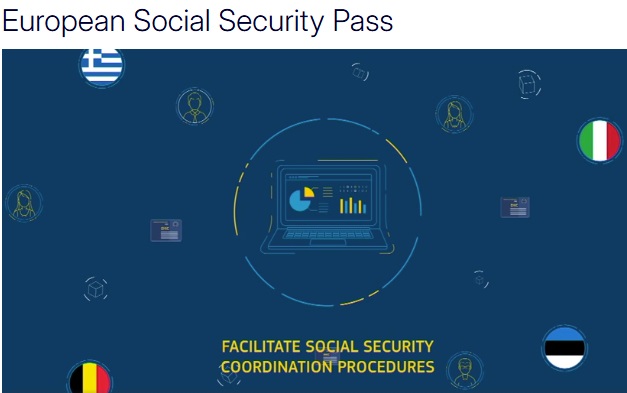
FIEC position on forthcoming ESSPASS legislation
Replying to the European Commission’s consultation on a forthcoming legislation on the European Social Security Pass (ESSPASS), FIEC welcomed the initiative and supported an advanced digitalised solution (i.e. interoperable EU solution based on the EU Digital Identity framework) while keeping enhanced paper documents for people not willing or being able to use digital solutions.
FIEC believes that the future ESSPASS legislation can streamline social security procedures for construction companies, in particular when requesting a Portable Document A1 in view of posting a worker abroad. Streamlined digitalised procedures can both reinforce and simplify the enforcement of social security rules, especially in a cross-border context. Fighting against unfair competition, as well as frauds and abuses against workers, in the construction sector is a key priority for FIEC.
| Read more |
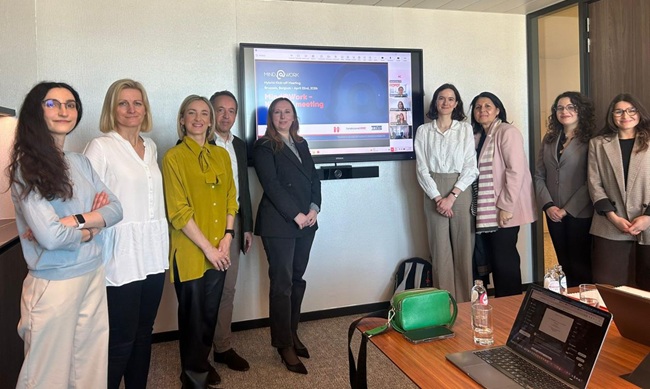
Mind@Work project kick-off meeting
On 22 April the official launch of the EU co-funded project Mind@Work (Mental Health in the Workplace: The Employer’s Perspective in Europe) marked the start of a two-year collaboration aimed at strengthening employers’ role in addressing mental health and psychosocial risks at work. The kick-off meeting was hosted by FIEC, as project coordinator in charge of leading the overall implementation, coordination, and delivery of the initiative.
The Mind@Work project, launched within the framework of the EEI (European Employers Institue : www.eei-institute.eu ), brings together a transnational consortium including the research organisation Fondazione ADAPT, with support from associated partners ECEG, HOTREC, EuroCommerce and Ceemet, as well as the affiliated entity ADAPT.
Mental health has become an increasingly important priority across Europe, with growing awareness of the impact of psychosocial risks on workers’ well-being, organisational performance and economic sustainability.
| Read more |
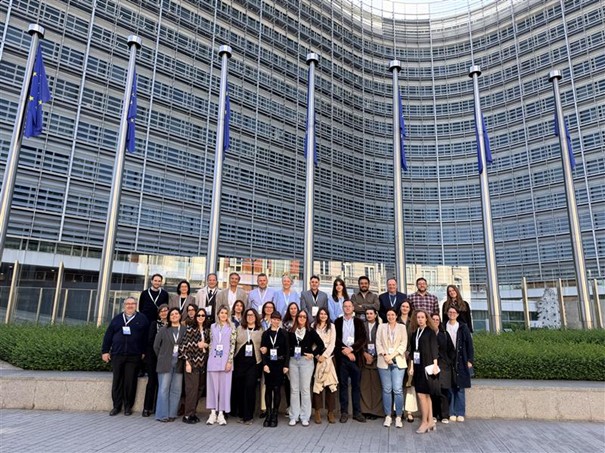
Construction Blueprint 2 – 3rd Transnational Project Meeting in Brussels
The Construction Blueprint 2 project, co-funded by the European Union’s Erasmus+ programme, held its third transnational project meeting on 23 and 24 April in Brussels. A key meeting in which the European consortium reviewed the progress of the activities under development, strengthened the collaboration between the partners and provide an update on the progress of the Pact for Skills initiative.
The meeting was co-organised by Belgium based partners, FIEC and European Builders Confederation (EBC) in collaboration with the coordinators of the initiative, the Construction Labour Foundation. It brought together representatives of the participating organisations from 10 European countries, together with experts from the European Commission who presented the Youth Guarantee and other tools to support youth employment.
In addition, the “Construction” unit within DG GROW presented the launch of the new European Construction Observatory and shared insight from the Skills Report.
Learn more on the project and developed outputs here:
| PROJECT |
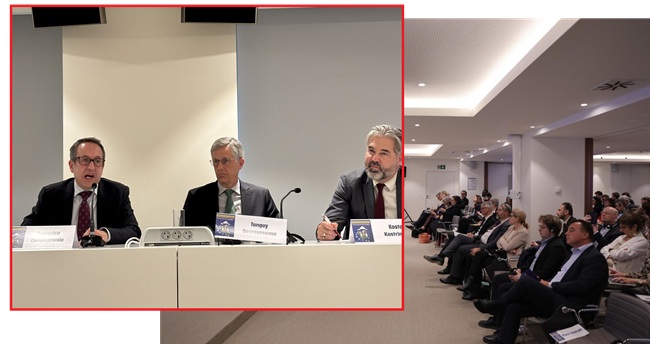
FIEC Director General recalls sector messages towards housing crisis
On 20th April, the French federation for social housing Union Sociale pour l’Habitat (USH) gathered EU and national stakeholders of the housing sphere to discuss the housing crisis and the role of social housing models in Europe. Whereas social housing across the EU represents around 10% of the housing stock, the various national presentations also demonstrated that it covers very different realities from one country to another.
Recalling FIEC priorities to boost affordable housing beyond social housing, FIEC Director General Domenico Campogrande highlighted the huge financing needs – i.e. around additional EUR 150 billion every year for new housebuilding and around additional EUR 170 billion every year for housing renovation. While the cost pressure remains a major constraint in construction and both companies and households depend on bank lending, prudential rules must remain proportionate for low-risk residential loans, to avoid unnecessarily constraining housing credit. He also insisted that the delivery of affordable housing requires much faster project pipelines. Full digitalisation and simplification of permitting procedures through mechanisms such as binding timelines can significantly improve delivery speed. The overall regulatory framework also needs to become more “housing friendly” and adapt to the complex reality of renovation and repurposing projects.
| Read more |
Survey on the the recognition of qualifications and skills of third-country nationals in the EU
As part of the Skills Portability Initiative, the European Commission is conducting a study under Action 3, which focuses on simplifying and streamlining the recognition of qualifications and skills of third-country nationals in the EU. To inform this work, they have launched a short survey aimed directly at non-EU nationals with experience of qualification recognition procedures in the EU.
The survey takes only 10–15 minutes to complete and is available at this link.
| Read more |
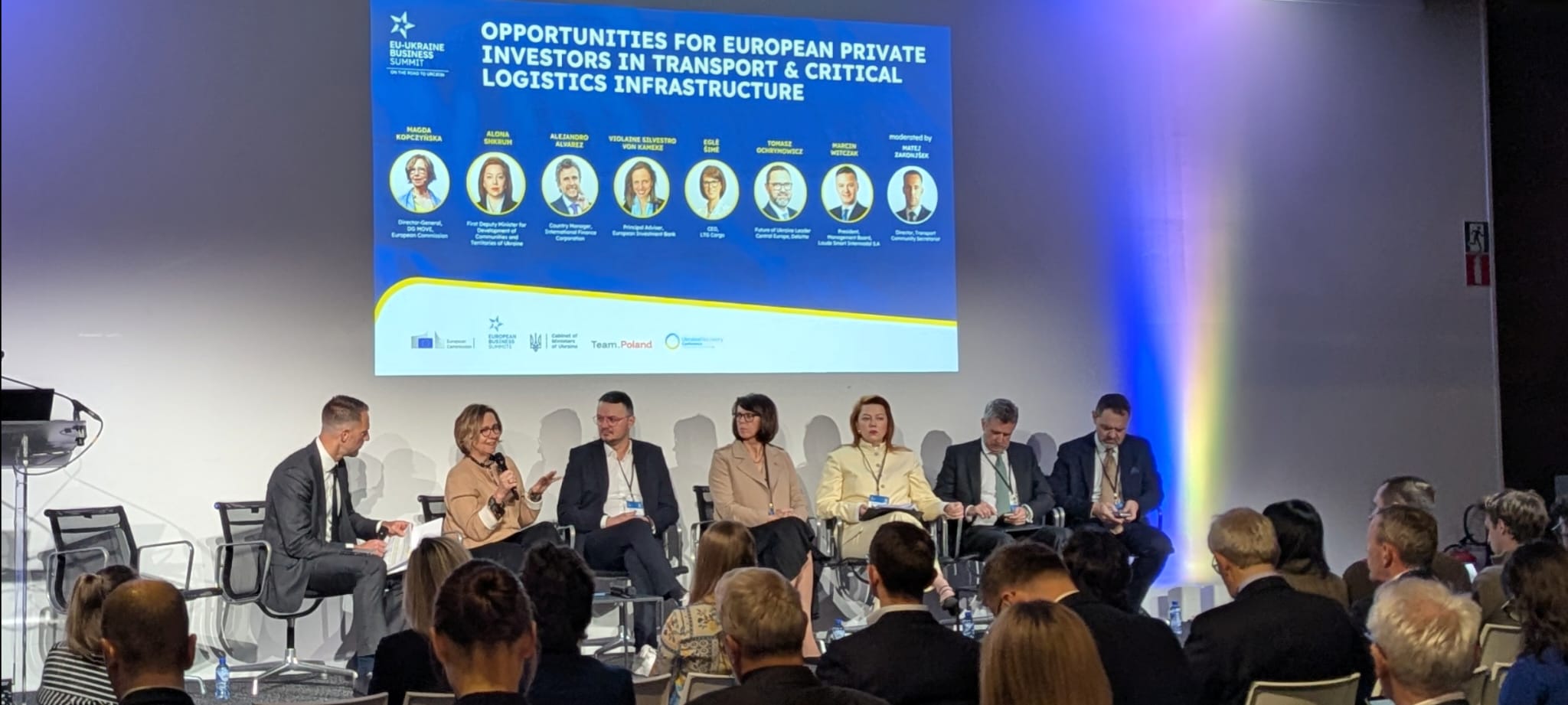
FIEC attends EU-Ukraine Business Summit 2026: concrete steps for infrastructure and SMEs
FIEC attended the EU-Ukraine Business Summit 2026 – On the Road to URC, held in Brussels on 22–23 April. The event brought together representatives from the European Commission, the Ukrainian government, international financial institutions and industry to discuss how to accelerate Ukraine’s recovery and strengthen its economic integration with the EU.
Among the discussions, two panels were particularly relevant for the European construction sector: the one on transport and critical logistics infrastructure, and the one on SMEs, business environment reforms and investment support instruments.
| Read more |
30 April: High Level Construction Forum Plenary meeting
FIEC will actively participate in the 6th plenary meeting of the High Level Construction Forum (HLCF) to be hosted by the European Commission (DG GROW) in Brussels on 30 April. The event will debate the strategic challenges faced by the construction ecosystem and how the EU institutions, together with the sector stakeholders, may address them in the future.
Joël Schons, Vice-President of FIEC will intervene as speaker.
The forum is bringing together policymakers, Member States and industry representative with a focus, among others, on the implementation of the European Strategy for Housing Construction, part of the broader EU Affordable Housing Plan.
Check out the event programme, which includes a plenary session and 3 workshops exploring how to translate the strategy into concrete actions.
More information on FIEC website.
| PROGRAMME |