



FIEC Statement on Ukraine: Four years of war – From resilience to reconstruction
Four years after Russia launched its full-scale invasion of Ukraine, FIEC reiterates its condemnation of this war of aggression and reaffirms its full solidarity with the Ukrainian people, including all those working for a just and lasting peace.
As Ukraine’s recovery and reconstruction needs are estimated at USD 587 billion, solidarity must now be matched with action-turning commitments into transparent, project-ready delivery on the ground. Through the joint FIEC–EIC Task Force “Ukraine”, developed in close cooperation with the Confederation of Builders of Ukraine (CBU), FIEC continues to support coordination, practical solutions and alignment with Europe’s standards and best practices.
In its statement, FIEC calls for:
- integrity-first reconstruction and open contracting;
- value for Europe and Ukraine with strong SMEs participation;
- alignment with EU standards and best-value procurement;
- stronger de-risking and financing tools;
- and a green, resilient rebuilding effort.
| STATEMENT |

Simplification of Sustainability Reporting published in EU Official Journal
Last week, Member States in the EU Council formally adopted the first Omnibus Simplification Package (OSP) on Sustainability Reporting. This marked the final procedural step, and the text has since been published in the EU Official Journal.
The simplification law will enter into force on 18 March, 2026. Member States will then have one year to transpose the provisions into national legislation, except for Article 4 on the level of harmonisation, which must be complied with by 26 July, 2028 at the latest.
FIEC welcomes the outcome of this simplification initiative, which strengthens both the credibility of EU sustainability policy and the competitiveness of European businesses.
| Read more |
“Skills Portability Initiative”: FIEC’s answer to the Call for Evidence
FIEC answered to the Call for Evidence on the “Skills Portability Initiative” launched by the European Commission. This legislative initiative will be presented in the framework of the Fair Labour Mobility package in the second half of 2026.
FIEC supports the overall objectives of the initiative, to ensure that qualifications and skills are portable across borders in the EU and to make the EU a more attractive place for talent.
Three actions are foreseen under this initiative:
- Action 1: A potential legislative proposal to facilitate worker mobility through improved transparency of skills and qualifications, and digitalisation;
- Action 2: Potential measures to facilitate modernise and expand recognition processes for regulated professions;
- Action 3: A potential legislative proposal for common rules to simplify procedures for the recognition of qualifications and skills of third country nationals;
FIEC welcomes this initiative but stresses the specificities of the construction sector: a well-established VET (Vocational Education and Training) system, a diversity in the regulated professions, the access to certain construction activities which is subject to specific national requirements, etc. In particular, FIEC welcomes EU initiatives to improve transparency of skills and qualifications and the use of digital tools.
FIEC also supports coordinated measures at EU level, involving the Member States and the relevant stakeholders as well as the social partners, to harmonise national instruments for the recognition of skills of third country nationals.
| FIEC’S ANSWER |
DESOCO3 Project Meeting on Subcontracting
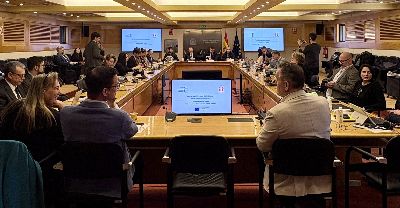
The European social partners for the construction industry, FIEC and the European Federation of Building and Woodworkers (EFBWW), met in Madrid on 24 February for the second thematic workshop within the framework of the EU-funded “DESOCO 3” project. Organised in collaboration with the Spanish National Construction Confederation (CNC) and held at the Spanish Economic and Social Council (CES) headquarters, the workshop focused on subcontracting in the construction sector in the EU and pursuing social dialogue to counter abusive and derived practices.
The meeting gathered representatives from across Europe to share and discuss experiences and best practices. The participants discussed a mapping study on subcontracting rules in construction in EU countries, presented by SPARK legal and Policy Consulting, as well as a report on liability schemes in cross-border subcontracting in EU countries by the European Labor Authority (ELA). The final outcomes of this report, yet to come, will enable to take informed proposals at an EU legislative framework level.
Key takeaways from the thematic workshop included identifying the main challenges faced by EU countries at their national level, notably limited transparency and weaknesses in fraud assessment mechanisms and tools. Participants also called for further digitalisation of the Single Market to support genuine cross-border activity, alongside a better enforcement of the existing regulatory frameworks.
| Read more |