




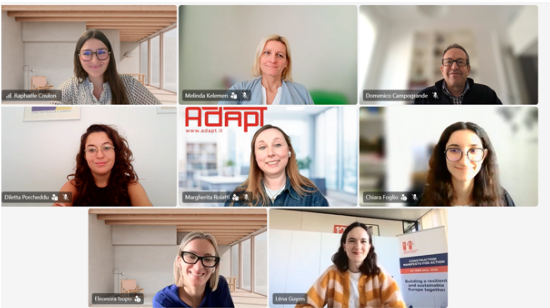
Mind@Work partners take stock of project progress
A particular focus was placed on the research activities led by Fondazione ADAPT. The desk research is now complete and gathers over 148 sources collected, including balanced documents from social partners and scientific literature. The interview activities have also reached an important milestone: the target of 10 interviews at national level with Employer’s organisations has been met, with a good balance across geographies and sectors, and analysis of the results is under way. In addition to, 5 interviews conducted at EU-level. The first impressions from the interviews point to a strong commitment among employers to addressing mental health at work, as well as great interest in learning from practices across other EU countries.The draft report on mental health at work is expected to be officially published in January 2026, alongside the 2nd policy brief, in the framework of our policy brief series.
Altogether, advancing the project’s overarching aim to strengthen employers’ role and perspective in addressing mental health in the workplace.
Find out more about the latest project developments and available materials at this link.
| MIND@WORK |

Proposal to review the European Standardisation Regulation
The proposal aims to modernise the European standardisation system, make it faster, increase the representation of SMEs, and better support the EU’s strategic interests.Harmonised standards matter directly to the construction sector. They shape the technical framework in which contractors specify, buy and install construction products. With this proposal, the European Commission responds to requests calling for a more innovation-friendly and responsive European standardisation system. The European Commission estimates that the average time to develop a standard would be shortened from six to four years.
FIEC will carefully analyse the proposal in detail. ‘Interim deliverables’, ‘external technical specifications’, ‘common specifications’, ‘standard in support of Union legislation’, and ‘referenced standard’ must not create a patchwork of references that makes it harder for contractors to know what applies, or that weakens the quality and legal clarity of the system. Faster procedures must remain compatible with the time and expert capacity that SMEs and contractors can invest in technical committees.
Standardisation must also continue to respect the established allocation of responsibilities between manufacturers and contractors, and the boundary between EU competence for construction products and Member State competence for design, assembly and construction works.
| READ MORE |

Contractors concerned: New EU standard could turn carpenters into manufacturers
On 6 October, the Construction Products Regulation (CPR) Acquis Expert Group of the European Commission met to discuss priorities for standards governing construction products on the EU Single Market. As a full member, FIEC contributes the contractors’ perspective as users of construction products.
FIEC is highly concerned that carpenters who produce and install doors and windows on site under a service contract could be treated as manufacturers in the future. They would then face the full set of obligations under the CPR. For artisan businesses, SMEs and micro-enterprises, this would mean a permanent product-data management burden that is hard to carry.
FIEC has warned against a resulting “carpenter exodus”. Member States are expected to vote on the standardisation request in the Committee on Standards (CoS) within this month.
| READ MORE |
EU survey on posting of workers
The European Commission is launching a survey on “posting of workers” to collect data needed to establish relevant indicators. The survey targets employers and employers’ organisations.
The answers must be provided by 29 October and the survey is accessible by clicking the below tab.
| SURVEY |
European Parliament plenary: Two votes on “Health and Safety at work”
On 6 October, the Members of the European Parliament (MEPs) approved in plenary session the agreement reached by the European Parliament and the EU Council on the sixth revision of the Carcinogens, Mutagens and Reprotoxic Substance Directive (CMRD) with 499 votes in favour, 49 against and 104 abstentions.
The Directive sets new limit value for polycyclic aromatic hydrocarbons (PAHs) and requests to the European Commission to assess the need to set limit values for welding fumes.
On the same day, MEPs also adopted the report from Estelle Ceulemans (BE/S&D) on psyschosocial risks, stress and mental health at work by 413 votes in favour, 210 against and 29 abstentions. The report calls the European Commission to propose new rules on work-related psychosocial risks. MEPs recommend employers to do regular psychosocial risk assessment and adopt action plans with concrete measures. They also recommend to establish individual return-to-work plans and to implement policies that prohibit violence and harassment at work.
The European Commission might address this issue in the forthcoming Quality Jobs Act.
| Read more |

October 2026 “EU Infringement Package”: Why implementation matters for construction
The European Commission’s action concerning Hungary’s long-term motorway contract raises important questions around the distinction between public contracts and concessions, risk allocation and contract modifications. These issues underline the importance of transparent procurement, appropriate risk allocation and legal certainty for major infrastructure projects.Standards and access
The Commission has opened an infringement procedure against France concerning access to mandatory national standards. Given the construction sector’s strong reliance on standards for the safety, quality and integrity of works, FIEC will follow this case closely, particularly in light of the Court of Justice of the European Union (CJEU)’s Malamud ruling and developments on the EU Product Act.Energy and buildings
The Commission has called on Greece, Spain, Italy and Malta to complete the transposition of the revised Energy Performance of Buildings Directive (EPBD). It has also urged Belgium, Czechia, Ireland, Italy, Luxembourg, Hungary, Malta, Poland and Slovakia to submit their draft National Building Renovation Plans. Effective implementation is essential to translate EU energy objectives into predictable renovation pipelines, investment and construction projects. Other cases concern the Urban Waste Water Treatment and Waste Framework Directives, as well as energy efficiency.Labour mobility and the Single Market
Cases concerning transport, professional qualifications and labour mobility highlight the continuing challenges faced by companies operating across borders. For FIEC, these developments reinforce the need for a well-functioning Single Market with less national fragmentation.
FIEC takeaway
Europe’s investment and competitiveness objectives depend not only on sound EU legislation, but also on its timely, consistent and proportionate implementation across Member States.
Full FIEC’s news article available here.
| READ PACKAGE |
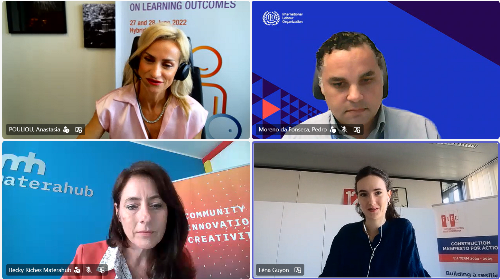
FIEC at CEDEFOP event on microcredentials
On 29 September, FIEC participated in a CEDEFOP online get-together to discuss the future of microcredentials and their role in lifelong learning and employment. Léna Guyon, FIEC Policy Officer, shared good practices and insights into the opportunities and challenges of using microcredentials in the construction industry.
If microcredentials can help to bridge the gap in the sector between initial education the new skills required for the green and digital transitions in the sector, their uptake remain fragmented among Member States. She highlighted the importance of support and guidance tools for the development of microcredentials but also for their portability and recognition across the EU.
| Read more |
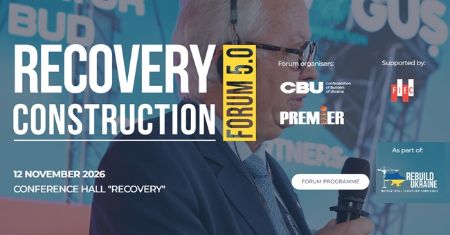
12 November, Warsaw: FIEC at “Recovery Construction Forum 5.0”
The Recovery Construction Forum 5.0 will take place on 12 November in Warsaw, bringing together Ukrainian and European construction stakeholders to discuss the priorities and practical challenges of Ukraine’s recovery and reconstruction.
FIEC will take an active role in the programme. Kjetil Tonning, FIEC Honorary President and Chair of the FIEC-EIC Task Force “Ukraine”, will moderate the opening session on “Housing Recovery 2027: Priorities, Financing & Scale”, together with Lev Partskhaladze, President of the Confederation of Builders of Ukraine (CBU), FIEC’s Ukrainian member federation.
Domenico Campogrande, FIEC Director General, will moderate a panel discussion “Large-Scale Housing Construction: Financing, Workforce, Technology & Quality”. The session will address some of the key conditions for scaling up housing construction in Ukraine, including financing and PPPs (Public Private Partnerships) models, the shortage of skilled construction workers, industrialised construction technologies, localisation of production, compliance with Eurocodes and requirements for energy efficiency, accessibility and durability. The discussion will also look at how BIM (Building Information Modelling) and digital monitoring can contribute to construction quality and the timely and cost-effective delivery of projects.
Click here to view the updated online forum programme and information on how to register.
| Read more |