





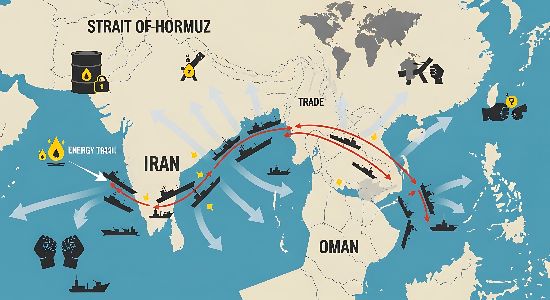
Strait of Hormuz: A growing risk for Europe’s construction sector
To assess the potential impact of a blockage of the Strait of Hormuz on the construction sector, FIEC carried out a flash survey among its members. One conclusion stands out clearly from the first responses: the main shock would first be a price and cost shock, rather than an immediate, generalised supply shortage.
Across Europe, bitumen and diesel appear as the two most consistently vulnerable inputs. More broadly, concerns also extend to oil-based products, petrochemical derivatives and highly energy-dependent materials. At this stage, the picture remains uneven: while some respondents report that operational difficulties are not yet visible on the ground, others already point to supply tensions or serious logistical pressure. The overall trend is therefore one of rapidly rising costs, increasing uncertainty for contractors, and growing concerns over transport and procurement, even before any widespread physical shortage has fully materialised.
Beyond rising costs, however, contractual issues are the source of greatest concern. In many countries, price revision mechanisms in public procurement do exist, but they remain too slow, too partial or too restrictive to absorb a sudden shock. The situation is even more concerning in countries that do not have such mechanisms, such as Spain. In private contracts, the picture is even more fragile, with difficult renegotiations, limited contractual protection and a growing risk of delays, claims or suspensions if tensions persist. Public responses also remain limited for now, suggesting that the sector is on alert while policy action is still at an early stage.
In conclusion, a clear message emerges from the survey. The sector needs more responsive price revision mechanisms, stronger safeguards against extreme volatility, and reinforced efforts to secure access to essential materials and inputs. If tensions around the Strait of Hormuz were to persist, Europe’s construction sector could quickly move from a cost shock to a broader operational disruption, with direct implications for housing, infrastructure and the wider European transition. Recent geopolitical developments only heighten these concerns. The announcement by Donald Trump regarding a potential blockage of the Strait of Hormuz is a stark reminder that a risk scenario could swiftly become reality.
EU Social Partners call for finding a deal on the revision of Social Security Coordination
Ahead of the resuming of trilogue negotiations around the revision of the Regulations 883/2004 and 987/2009 on the coordination of social security systems across the EU, the cross-sectoral social partners (i.e. BUSINESSEUROPE, SME United, SGI Europe and ETUC) issued a Joint Statement, calling EU institutions to eventually close a deal on this cornerstone legislation for the free movement within the EU.
Social partners insist that this revision shall be the opportunity to implement a more digitalised approach to procedures related to social security.
They also advocate that this revision needs to ensure that mandatory prior notification constitutes the general rule – and only rule for the construction sector, as jointly requested by FIEC, EFBWW and EBC.
| Read more |

EU Public Procurement reform: Strategic ambition must be matched by workable rules
One of the report’s most important messages is the clear gap between private-sector respondents and public authorities. Across the first-section ranking exercises, companies, SMEs and business associations consistently gave greater weight to moving beyond the lowest-cost paradigm, prioritising quality over price and strengthening preference for European industry in critical sectors.Public authorities took a different view: they ranked flexibility, less detailed rules and the avoidance of additional administrative burden above most other objectives. The same divide appears in the detailed questions, where a narrow majority of respondents (51%) supported making the best price-quality ratio the standard award criterion, while support among public authorities was far lower (22%).This is a crucial distinction for the reform debate. It shows that the real challenge is not simply to make procurement more strategic, but to do so in a way that remains manageable for contracting authorities.
For the construction sector, this balance will be decisive. The report shows strong support for practical measures that would make a real difference on the ground: the re-use of bidder documentation under the once-only principle (87%), model contract templates and technical specifications (75%), interconnection of national eProcurement services (65%), faster payments to contractors, especially SMEs (66%), clearer rules for the post-award phase (52%) and direct payments to subcontractors (51%). Respondents also expected such reforms to increase SME participation (82%), attract more bidders (81%), increase competition (81%) and speed up procedures (81%).
For FIEC, the direction is therefore clear. Europe should move towards procurement that rewards quality, sustainability, innovation and resilient European value chains, rather than lowest price alone. This direction is largely consistent with the consultation responses, which show broad support for incentives for green procurement (71%), socially responsible procurement (64%) and innovation procurement (74%), as well as strong support among all respondent groups except non-EU participants for prioritising European goods and services.
At the same time, respondents also expect higher prices and additional administrative burdens if strategic objectives are translated into rigid or overly complex rules. This shift will therefore succeed only if the future framework also reduces unnecessary complexity, strengthens legal certainty and reflects the practical realities of delivering works contracts. A successful reform must be both more strategic and more workable.
| Read more |
Eurobridge 2026: Infrastructure maintenance back at the heart of the European agenda
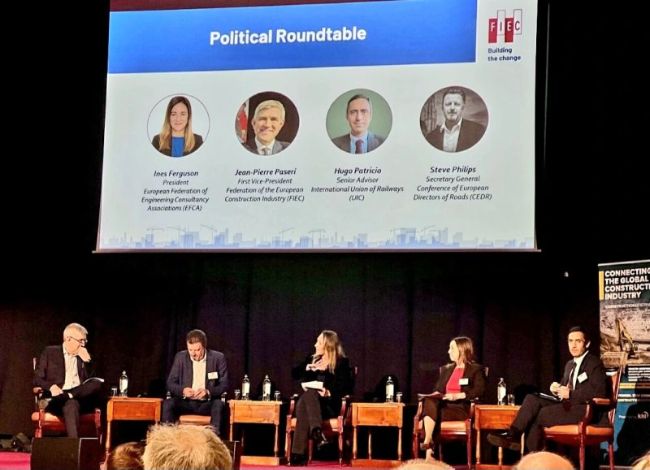
At the 5th edion of Eurobridge 2026, held in Brussels on 10 April, discussions highlighted a clear message: infrastructure must be seen not only as a mobility issue, but also as a key driver of competitiveness, resilience and strategic autonomy. Bringing together representatives from construction, rail, road and engineering sectors, the event provided a timely exchange on the future priorities for transport infrastructure in Europe.
The political roundtable, with the participation of FIEC First Vice-President Jean-Pierre Paseri, stressed the need to give infrastructure a stronger place in EU policymaking. Participants called for a more balanced approach between maintaining existing assets and investing in new projects, alongside simplification of rules and better prioritisation of investments. The importance of moving beyond a purely cost-driven approach towards a value-based perspective — including lifecycle performance and resilience — was also underlined.
Discussions also pointed to the growing role of infrastructure in addressing new challenges, including military mobility and supply chain security, which require more robust, interconnected and reliable networks. At the same time, the scale of investment needs highlights the urgency of mobilising both public and private financing solutions.
The programme further reinforced these messages through dedicated sessions on infrastructure maintenance models, skills adaptation and resilience, confirming that Europe needs a more strategic, long-term approach to infrastructure.
For FIEC, Eurobridge confirmed that a competitive and innovative construction sector is essential to deliver, maintain and adapt the infrastructure Europe needs.
| Read more |
European Commission proposes revision to improve predictability of emission costs
The European Commission has proposed a targeted revision of the EU Emissions Trading System (EU ETS) to enhance its stability and the predictability of costs. The proposal focuses on the Market Stability Reserve (MSR), which is designed to adjust the supply of carbon allowances under certain circumstances.
According to the proposal, the automatic invalidation of allowances above the current threshold would be discontinued, and instead retained as a buffer. This adjustment aims to strengthen the system’s ability to respond to market imbalances and potential future supply constraints.
For FIEC, the EU ETS remains a central, market-based tool to drive industrial decarbonisation. Predictability and consistency are essential to steer investment in low-carbon technologies and to support the market uptake of alternative construction materials.
| Read more |
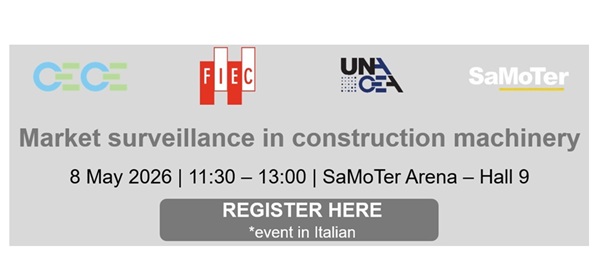
SaMoTer fair: Market Surveillance in Construction Equipment and Machinery
CECE, UNACEA, and FIEC are co-organising an information session on “Market surveillance in construction machinery” during the SaMoTer fair that will take place on 8 may in Verona, Italy.
With the launch of the online platform for compliant equipment, the focus of the information session will be on collaboration and the exchange of best practices and a representative of the European Commission will present the draft reform of the European market surveillance legislation.
Click on on this link to register.
Please view hereunder or download the programme (Italian) of the event, which will be held in Italian.
| PROGRAMME |